Bible Translations That Use The Divine Name

Click Images of Bibles to Download

King James Version (1611)
The Authorized Version, commonly known as the King James Version, the King James Bible or simply the KJV, is an English translation by the Church of England of the Christian Bible begun in 1604 and completed in 1611. First printed by the King’s Printer, Robert Barker, this was the third such official translation into English; the first having been the Great Bible commissioned by the Church of England in the reign of King Henry VIII, and the second having been the Bishop’s Bible of 1568. In January 1604, King James I of England convened the Hampton Court Conference where a new English version was conceived in response to the perceived problems of the earlier translations as detected by the Puritans, a faction within the Church of England.
James gave the translators instructions intended to guarantee that the new version would conform to the ecclesiology and reflect the episcopal structure of the Church of England and its beliefs about an ordained clergy. The translation was by 47 scholars, all of whom were members of the Church of England. In common with most other translations of the period, the New Testament was translated from Greek and the Old Testament was translated from Hebrew text.
King James Version (1611), renders Jehovah in Exodus 6:3, Psalm 83:18, Isaiah 12:2, Isaiah 26:4, and three times in compound place names at Genesis 22:14, Exodus 17:15 and Judges 6:24.
The Emphatic Diaglott
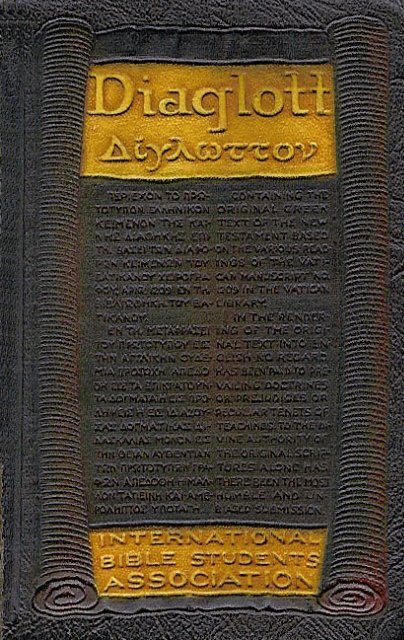
This is a diaglott, or two-language polyglot translation, of the New Testament by Benjamin Wilson, first published in 1864. It is an interlinear translation with the original Greek text and a word-for-word English translation in the left column, and a full English translation in the right column. It is based on the interlinear translation, the renderings of eminent critics, and various readings of the Vatican Manuscript. It includes illustrative and explanatory footnotes, references, and an alphabetical appendix.
The Greek text is that of Johann Jakob Griesbach. The English text uses “Jehovah” for the divine name a number of times where Griesbach uses “κύριος” (the Lord) when quoting Hebrew scriptures. For example, at Luke 20:42-43 it reads: “For David himself says in the book of Psalms, Jehovah said to my Lord, sit thou at my Right hand, ’till I put thine enemies underneath thy feet”, where Jesus quoted Psalm 110:1.
After Wilson’s death in 1900, the plates and copyright were inherited by his heirs. Charles Taze Russell, then president of the Watch Tower Bible and Tract Society, approached Wilson’s family and obtained the copyright, and at some later point, the plates. The Society published the Diaglott in 1902, and later had the type reset for publication on its own presses in 1927, with an additional printing in 1942.
In 1952 the copyright to the Diaglott expired and it fell into the public domain. The Watch Tower Society sold the Diaglott inexpensively, offering it free of charge from 1990.
The Divine name is rendered “Jehovah” in the following places:
Matthew 21:9,42; 22:37,44; 23:39
Mark 11:9; 12:11,29f,36
Luke 10:27; 13:35; 19:38; 20:37,42
John 12:13
Acts 2:34
The Darby Bible (1890)
The Darby Bible (DBY, formal title The Holy Scriptures: A New Translation from the Original Languages by J. N. Darby) refers to the Bible as translated from Hebrew and Greek by John Nelson Darby. Darby published a translation of the New Testament in 1867, with revised editions in 1872 and 1884. After his death, some of his students produced an Old Testament translation based on Darby’s French and German translations. The complete Darby Bible, including Darby’s 3rd edition New Testament and his students’ Old Testament, was first published in 1890.
J N Darby’s purpose was, as he states in the preface to his English NT, to make a modern translation for the unlearned who have neither access to manuscript texts or training and knowledge of ancient languages of the Scriptures. He was the principal scholar for a number of translations – and not the sole translator of any one of the various translations that bear his name. He acknowledges dependence on the critical work of Samuel Prideaux Tregelles and various other scholars.
In the Old Testament Darby translates the covenant name of God as “Jehovah” instead of rendering it “LORD” or “GOD” (in all capital letters) as most English translations do. Among other widely-used translations only Robert Young’s Literal Translation, the American Standard Version (1901), and the New World Translation (1950) have followed this practice. However even the footnotes of many editions (such as the 1961 Modified Notes Edition) of Darby Bible’s New Testament indicate where “Lord” (“Kurios” in Greek) in the scripture text probably refers to Jehovah. The 1961 Modified Notes Edition of the Darby Bible includes the 1871 New Testament Preface, which says in part “All the instances in which the article is wanting before Kurios are not marked by brackets; but I give here all the passages in which Kurios, which the LXX employ for Jehovah, thence transferred to the New Testament, is used as a proper name; that is, has the sense of ‘Jehovah.'” It then gives a listing of those places.

Young’s Literal Translation (1862)
Young’s Literal Translation is a translation of the Bible into English, published in 1862. The translation was made by Robert Young, compiler of Young’s Analytical Concordance to the Bible and Concise Critical Comments on the New Testament.
Young produced a “Revised Version” of the translation in 1887. After he died on October 14, 1888, the publisher in 1898 released a new Revised Edition.
The Literal Translation is unusual in that, as the name implies, it is a strictly literal translation of the original Hebrew and Greek texts, and makes no changes for ease of reading in English.
Youngs Translation consistently renders the Hebrew Tetragrammaton (divine name) throughout the Old Testament as “Jehovah”, instead of the traditional practice of representing the Tetragrammaton in English as “LORD” in small capitals.
American Standard Version (1901)
The Revised Version or more commonly known as the American Standard Version (ASV), was released in 1901.
The divine name of the Almighty (the Tetragrammaton) is consistently rendered Jehovah in the ASV Old Testament, rather than Lord as it appears in the King James Bible.
The reason for this change, as the Committee explained in the preface, was that “…the American Revisers…were brought to the unanimous conviction that a Jewish superstition, which regarded the Divine Name as too sacred to be uttered, ought no longer to dominate in the English or any other version of the Old Testament…”
Other changes in the ASV included substituting “who” and “that” for “which” when referring to people, and Holy Ghost was dropped in favor of the Holy Spirit.
The ASV was the basis of four revisions. They were the Revised Standard Version (1946-1952/1971), the Amplified Bible (1965), the New American Standard Bible (1963-1971/1995), and the Recovery Version (1999).
A fifth revision is the World English Bible. The ASV was also the basis for Kenneth N. Taylor’s Bible paraphrase, The Living Bible, which was published in 1971.

Rotherham’s Emphasized Bible (1902)
Rotherham’s Emphasized Bible (abbreviated EBR) is a translation of the Bible that uses various methods, such as “emphatic idiom” and special diacritical marks, to bring out nuances of the underlying Greek, Hebrew, and Aramaic texts. It was produced by Joseph Bryant Rotherham, a bible scholar and minister, who described his goal as “placing the reader of the present time in as good a position as that occupied by the reader of the first century for understanding the Apostolic Writings.”
The New Testament Critically Emphasised was first published in 1872. However, great advances occurred in textual criticism during the last half of the 19th century culminating in Brooke Foss Westcott’s and Fenton John Anthony Hort’s Greek text of the New Testament. This led Rotherham to revise his New Testament twice, in 1878 and 1897, to stay abreast of scholarly developments.
The entire Bible with the Old Testament appeared in 1902. Rotherham based his Old Testament translation on Dr. C. D Ginsburg’s comprehensive Masoretico-critical edition of the Hebrew Bible that anticipated readings now widely accepted.
Rotherham uses the form “Yahweh” to translate the Divine Name throughout the Old Testament.

The Bible in Living English
Steven Tracy Byington (1869 – October 12, 1957) was a noted intellectual, translator, and American scholar.
Byington was a graduate of the University of Vermont in 1891 and a member of the prestigious Phi Beta Kappa. He was considered a master of at least twelve languages, including many classical languages.
His writings included observations on new forms and changed usage of English words, publishing 25 articles in the journal “American Speech” from 1926-1946. However, he had a speech impediment which made preaching difficult so despite his training, he spent many years working as a proofreader .
Over the course of sixty years he translated the Bible from original texts and entitled it “The Bible in Living English”. It was published posthumously in 1972 in New York by the Watchtower Bible and Tract Society.
A notable characteristic of this translation was the use of God’s Name which Byington translated Jehovah in the Old Testament. Byington states in his preface: “The spelling and the pronunciation are not highly important. What is highly important is to keep it clear that this is a personal name. There are several texts that cannot be properly understood if we translate this name by a common noun like Lord, or, much worse, by a substantialized adjective”.

Westcott & Hort Greek New Testament (1881).
The New Testament in the Original Greek is the name of a Greek language version of the New Testament published in 1881. It is also known as the Westcott and Hort text, after its editors Brooke Foss Westcott (1825–1901) and Fenton John Anthony Hort (1828–1892). It is a critical text, compiled from some of the oldest New Testament fragments and texts that had been discovered. They worked together for 28 years.
Westcott and Hort state: “our belief that even among the numerous unquestionably spurious readings of the New Testament there are no signs of deliberate falsification of the text for dogmatic purposes.”
According to Hort: “Knowledge of Documents should precede Final Judgments upon Readings”. Two manuscripts were favored by Westcott and Hort: Vaticanus and Sinaiticus. They also believed that the combination of Codex Bezae with the Old Latin and the Old Syriac represents the original form of the New Testament text, especially when it is shorter than other forms of the tradition.
The New World Translation of the Holy Scriptures uses extensively the “New Testament in the Original Greek” by Westcott and Hort (originally published in 1881) and the work of the two 19th century scholars is often commented upon favorably in Watchtower publications.
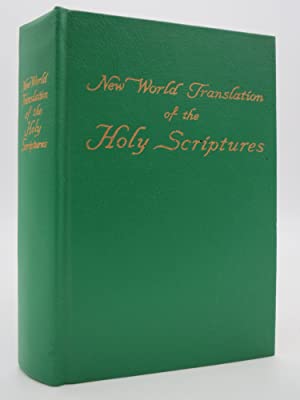
The New World Translation (1961).
The New World Translation of the Holy Scriptures (NWT) is a translation of the Bible published by the Watch Tower Bible and Tract Society in 1961; it is used and distributed by Jehovah’s Witnesses. Though it is not the first Bible to be published by the society, it is their only original translation of ancient Classical Hebrew, Koine Greek, and Old Aramaic biblical texts. As of 2011, the Watch Tower Society has published 168 million copies of the New World Translation in 103 languages
Until the release of the NWT, Jehovah’s Witnesses in English-speaking countries generally used the King James Version or American Standard Version of the Bible. According to the publishers, one of the main reasons for producing a new translation was that most Bible versions in common use, including the Authorized Version (King James), employed archaic language. The stated intention was to produce a fresh translation, free of archaisms. Additionally, over the centuries since the King James Version was produced, more copies of earlier manuscripts of the original texts in the Hebrew and Greek languages have become available. Better manuscript evidence had made it possible to determine with greater accuracy what the original writers intended, particularly in more obscure passages. Linguists better understood certain aspects of the original Hebrew and Greek languages than previously.

In October 1946, the president of the Watch Tower Society, Nathan H. Knorr, proposed a fresh translation of the New Testament, which Jehovah’s Witnesses usually refer to as the Christian Greek Scriptures.Work began on December 2, 1947 when the “New World Bible Translation Committee”, composed of anointed Jehovah’s Witnesses, was formed. The committee agreed to turn over its translation to the Society for publication and on September 3, 1949, Knorr convened a joint meeting of the board of directors of both the Watch Tower Society’s New York and Pennsylvania corporations where he again announced to the directors the existence of the committee and that it was now able to print its new modern English translation of the Christian Greek Scriptures. The directors were read several chapters from the translation and then voted unanimously to accept it as a gift.

The New World Translation of the Christian Greek Scriptures was released at a convention of Jehovah’s Witnesses at Yankee Stadium, New York, on August 2, 1950. The translation of the Old Testament, was released in five volumes in 1953, 1955, 1957, 1958, and 1960. The complete New World Translation of the Holy Scriptures was released as a single volume in 1961, and has since undergone minor revisions. Cross references which had appeared in the six separate volumes were updated and included in the complete volume in the 1984 revision. In 1961 the Watch Tower Society began to translate the New World Translation into Dutch, French, German, Italian, Portuguese, and Spanish; the New Testament in these languages were released simultaneously on July 1963 in Milwaukee, Wisconsin. By 1989 the New World Translation was translated into eleven languages, with more than 56,000,000 copies printed.
In its review of Bible translations released from 1955 to 1985, The HarperCollins Bible Dictionary listed the New World Translation as one of the major modern translations. The New Catholic Encyclopedia says of the NWT reference edition: “The Jehovah’s Witnesses’ translation of the Bible (NWT) has an impressive critical apparatus. The work is excellent”. (G. HÉBERT/EDS, “Jehovah’s Witnesses”, The New Catholic Encyclopedia, Gale, 20052, Vol. 7, p. 751). A 2003 study by Jason BeDuhn, associate professor of religious studies at Northern Arizona University in the United States, of nine of “the Bibles most widely in use in the English-speaking world,” including the New American Bible, The King James Bible and The New International Version, examined several New Testament passages in which “bias is most likely to interfere with translation.” For each passage, he compared the Greek text with the renderings of each English translation, and looked for biased attempts to change the meaning.
BeDuhn reported that the New World Translation emerged “as the most accurate of the translations compared”, and a “remarkably good translation”.
CLICK HERE to visit JW.org to download 2013 edition